DAMA-BAX applies multipoint Bayesian Algorithm Execution to one of the costliest calculations in storage-ring design: choosing the sextupole settings that give a lattice the largest dynamic and momentum apertures. Instead of simulating a full particle map for every candidate lattice, it simulates one particle at a time, only where the answer could move the Pareto front. It ships as the open-source mpBAX framework, later the testbed for an LLM-agent autoresearch program.
- 40–90×end to end · ≈1k vs ≈38k core-hours
- >400×optimization loop · ≈100 vs ≈38k core-hours
- 11.40 vs 10.80agent-built vs hand-tuned optimizer, hypervolume
Why
Sextupole magnets correct a ring's chromaticity but shrink the region of stable motion. The dynamic aperture (DA), the area of transverse positions from which an injected particle survives, sets injection efficiency; the momentum aperture (MA), the energy kick a particle can absorb and still stay in the ring, sets beam lifetime. Both bound photon flux and trade against each other, so designers look for a Pareto front.
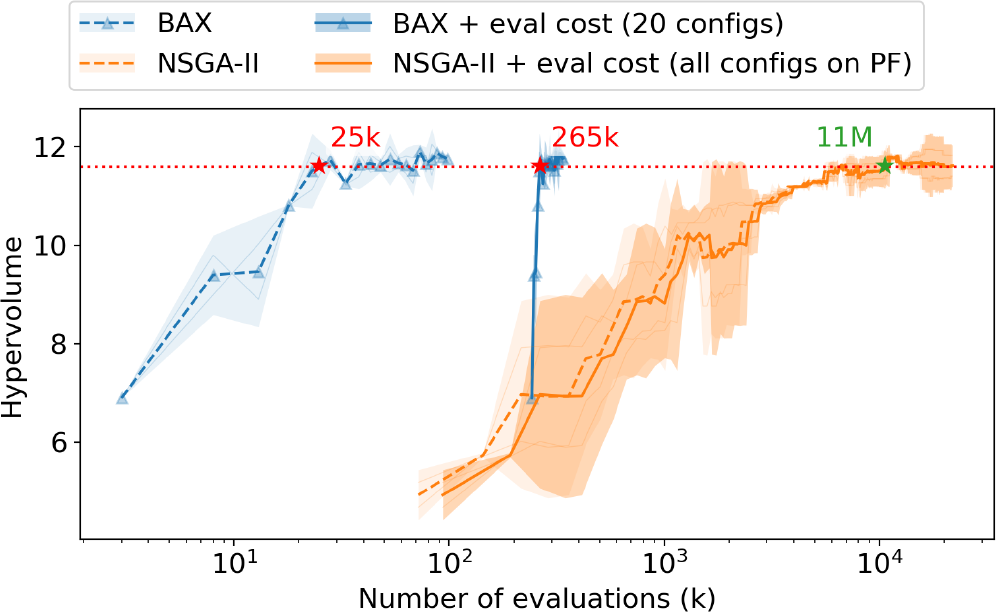
Scoring one candidate lattice means tracking thousands of particles for thousands of turns: a multipoint objective, where every optimizer step hides a scan over the particles' starting coordinates. Production genetic and swarm optimizers afford on the order of a thousand candidates per study; the paper's NSGA-II baseline used some 22 million tracking simulations. Unlike Badger's online tuning of a running machine, this is a design problem; the cost is compute.
How
Bayesian optimization fits a Gaussian process to configuration → area and picks the next full map to simulate. BAX instead models the physics under the objective (configuration and particle position → turns survived), runs the design algorithm itself (DA and MA areas, then NSGA-II) on the surrogate to predict the Pareto front, and asks only for simulations that would change that prediction.
- Single-particle acquisitions. Each acquisition returns one particle's survival, batched fifty at a time; full maps are tracked only at the end, to verify the chosen configurations.
- Algorithm-driven sampling. Points come only from configurations predicted near the Pareto front, at positions near the stability boundary, where a simulation carries information.
- A neural field instead of a GP. Over a hundred thousand points rule out a Gaussian process; the surrogate is a neural network from lattice knobs and particle coordinates to survived turns, finetuned every loop.
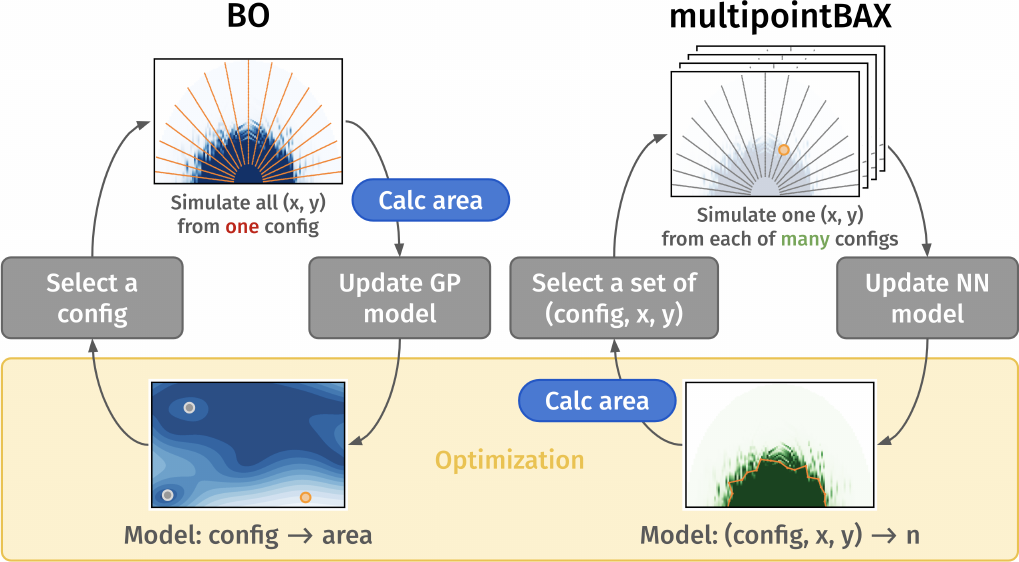
The method is packaged as mpBAX: YAML-configured experiments, one oracle and model per objective, per-loop checkpoints with resume and rollback, and four overridable engine stages, on NumPy and PyYAML only.
Results
The test case is SSRL-X, a proposed fourth-generation upgrade of the Stanford Synchrotron Radiation Lightsource: a hybrid six-bend achromat lattice with 86 pm natural emittance, its six sextupole families reduced to four chromaticity-neutral knobs. multipointBAX reached the NSGA-II hypervolume with a speed-up of 40–90× end to end (≈1k vs ≈38k core-hours), and more than 400× in the optimization loop itself (≈100 vs ≈38k core-hours). The gap is the final verification, which on a four-knob problem dominates BAX's budget and shrinks on harder problems.
Autoresearch
In 2026 the optimizer became a testbed for autonomous research agents. The autoresearch framework was built at LBNL by T. Hellert (autoresearch-commissioning); our group was its first external user, adapting it to DAMA-BAX optimization. Agents propose one code change at a time to the acquisition strategy, budget split or surrogate architecture; a fixed harness scores it on a held-out error seed; only improvements are merged. Over hundreds of experiments the cleanest test was a benchmark shipped with its surrogate deliberately crippled to a single linear layer. One experiment rebuilt it to the hand-tuned reference; in a second run the agents surpassed that reference within seven experiments (hypervolume 11.40 vs 10.80).
What I did. First author of seven (SLAC, DESY, LBNL, USC); sole developer of mpBAX; ran the autoresearch program on the DAMA-BAX side.
Preprint: arXiv:2511.17850 (2025). Core-hour comparisons as reported in the paper. Autoresearch hypervolumes come from the internal campaign review.